


Nature & Biodiversity in the Built Environment
Nature is in crisis, but the built environment has the potential to be part of the solution through planning and design that protects, restores, and enhances biodiversity.
 credits: Scott Tallon Walker
Nature is in crisis. Ireland declared a Biodiversity and Climate Emergency in 2019, and the focus on biodiversity and the built environment has increased significantly since then.
The construction and built environment sectors are highly reliant on biodiversity and ecosystem services. Despite this, current spatial patterns of development and methods of construction often hurt nature.
Biodiversity Crisis
There are clear links between four of the five main sources of biodiversity loss identified by the Intergovernmental Science-Policy Platform on Biodiversity and Ecosystem Services (IPBES) and the built environment, namely changes in land use, climate change, pollution, and invasive alien species. These impacts happen on-site (e.g., habitat destruction and fragmentation) and off-site, where construction materials are produced.
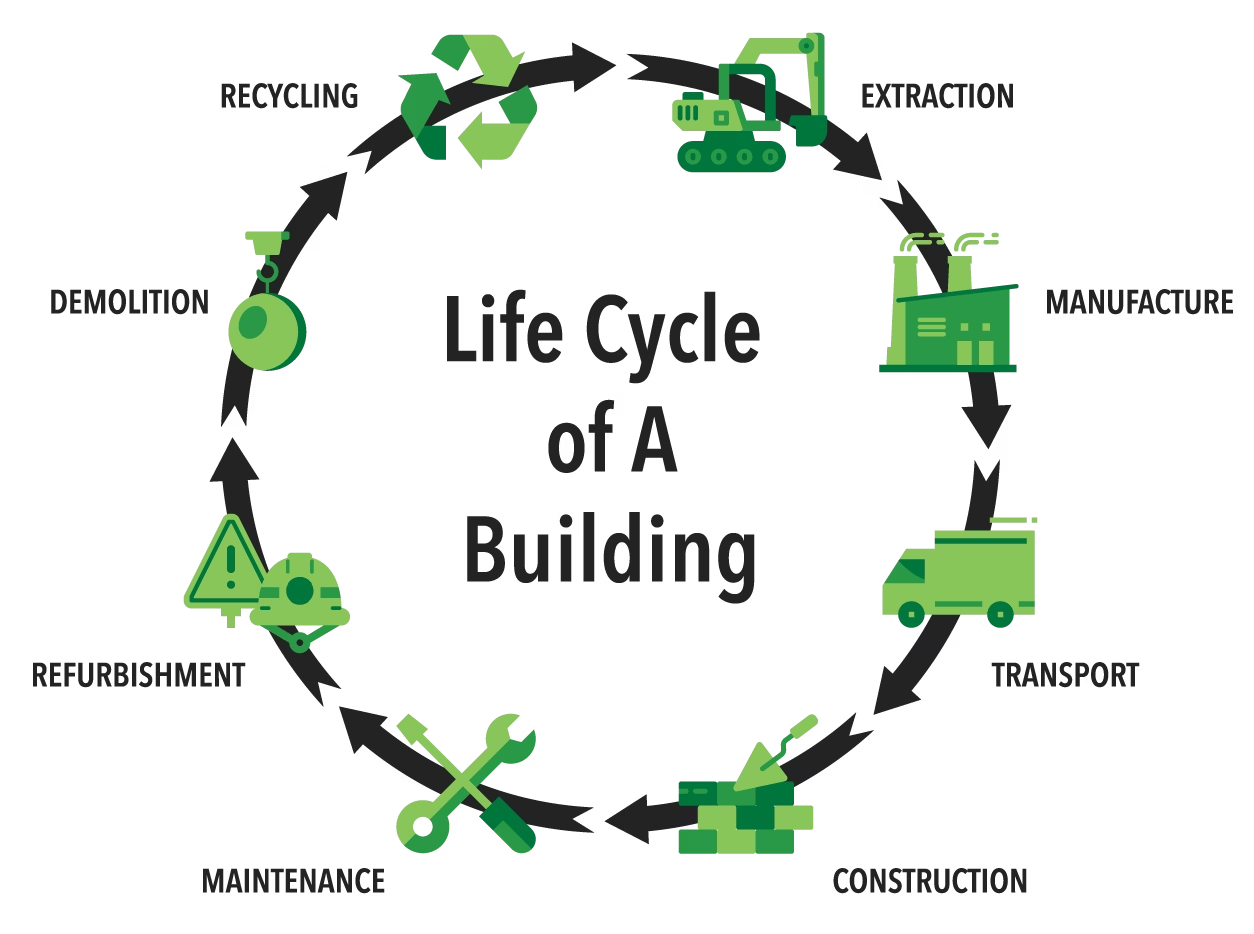
It’s therefore crucial to consider the impact at all levels – on site (project level), local area (biodiversity corridors) and off-site, and throughout the whole life cycle of the building, not just at the design and construction phase.
A well-planned and designed built environment that takes a positive approach to protecting and enhancing biodiversity can provide many benefits to society, from preventing flooding and overheating risks to improving people’s health and well-being.
Biodiversity On Site: Mitigation Hierarchy
The Mitigation Hierarchy sets out a sequence of steps to follow when planning and implementing projects, aiming to protect and enhance biodiversity. Applied throughout a project’s lifecycle, it establishes a sequence of actions designed to achieve either No Net Loss or Net Gain for nature.
Step 1: Avoid
The first step in any strategy should be to avoid creating negative impacts from the outset. This involves careful site selection, thoughtful layout design, and, where necessary, timing construction activities to minimise disturbance. Avoidance is the most effective and reliable form of mitigation and must be given the highest priority. To enable this, biodiversity considerations need to be integrated from the earliest stages of project planning.
Step 2: Minimise
When avoidance is not feasible, it is essential to minimise negative impacts on existing habitats. This can be achieved by adjusting the project design and strategy to reduce the duration, intensity, and extent of the impacts that cannot be completely avoided.
Step 3: Restore
Once impacts have been avoided and minimised, the next priority is to rehabilitate or restore damaged ecosystems and habitats once the activity is completed. For Net Gain, this will mean not only restoring but enhance existing habitats.
Step 4: Offset
The last resort is to explore opportunities for creating new habitats with greater ecological value, which can provide ecosystem services. This can be done on-site or off-site and may involve more complex and costly approaches, such as the installation of green roofs.

Embodied Ecological Impacts
While the focus in construction is often on impacts that happen during construction, it’s important to highlight that 90% of biodiversity loss comes from the extraction of materials (UNEP report 2019), and 50% of mineral extraction is for use in construction.
Embodied Ecological Impacts are impacts that happen off-site via upstream or downstream activities, such as habitat loss or environmental damage caused by material extraction and manufacturing.
Ultimately, between 75 and 95% of impacts on biodiversity happen off-site (Wilting and van Oorschot, 2017).
To address Embodied Ecological Impacts in your projects, you can:
1 Minimise the amount of material needed
All materials have an impact, so use as little material as possible.
2 Prioritise reused materials
The extraction stage has the most significant biodiversity impact -> reusing existing materials could significantly reduce biodiversity impacts.
3 Utilise existing responsible sourcing and certification schemes
Responsible sourcing schemes and certifications for some materials can help to address biodiversity impacts. Practitioners can use these to ensure that a supplier has at least considered biodiversity.
4 Understand where materials have been sourced from
Materials with longer and more complex supply chains are harder to analyse in terms of biodiversity impact, as there is greater uncertainty. Where materials are not covered by certification, practitioners should specify and source materials with clear provenance. Engage with the supply chain to get information.
IGBC’s work in this field

Since 2023, Biodiversity has been one of the key priorities for the IGBC, and the IGBC Biodiversity Team has provided resources to help the construction and property industry embed biodiversity in their processes and projects. We have set up a Community of Practice which takes place quarterly, as well as a biodiversity newsletter for members, plus various publications and a series of webinars.
Webinar Series
We hosted a successful “Biodiversity & the Built Environment” Webinar series – funded by the Department of Housing and now available for free on our on-demand platform, attended by more than 700 building professionals.
Factsheet & Checklist
We released a “Biodiversity and the Built Environment – IGBC’s Insights” publication and a “Biodiversity Checklist of the 10 things to do for a better Built Environment.”
The “Rate Team” also developed “Biodiversity in your Neighbourhood” – a list of biodiversity options for developers based on the Home Performance Index (HPI) Indicator EN 5.0 Ecology.
Community of Practice

In 2023 we launched our “Biodiversity and the Built Environment” Community of Practice for our members – a networking group for building professionals and property managers to share information on challenges and best practices, and to learn from each other. Read more here about the launch. So far, we have discussed topics such as Nature-based Solutions, Embodied Ecological Impacts, Biodiversity in new Builds, Planning for Biodiversity, creating a Strategy for Biodiversity and more. Check our events page to find the next upcoming meeting.
Newsletter
IGBC members interested in biodiversity and nature-based solutions receive a quarterly newsletter which includes a policy update, information about our initiatives, key reading and video materials. If you are a member and you want to receive this update, contact [email protected] to ensure you are enrolled as a member.
Tours

We organise tours with experts for our Community of Practice and IGBC members, providing them with opportunities to see real-life examples of green infrastructure and other solutions that enhance biodiversity in buildings and infrastructure. Have a project you’d like to showcase with a tour? Get in touch with Irene!
Projects


Guide
Related content
-

Circularity & Resource Efficiency in the Built Environment
Designing buildings for longevity, adaptability, and reuse is key to creating a resource-efficient and circular built environment. -

Carbon Emissions & Net Zero in the Built Environment
The built environment has a critical role to play in addressing climate change by reducing both operational and embodied carbon emissions. -

Climate Adaptation and Resilience in the Built Environment
As climate risks increase, resilient buildings and neighbourhoods are critical to protecting people, places, and infrastructure. -

Health & Wellbeing in the Built Environment
Sustainable buildings are not only good for the planet, they are essential for healthier, fairer, and more resilient communities. -

Life Cycle GWP Assessment – Methods and Resources
Overview The Irish Green Building Council (IGBC), as part of the INDICATE initiative, has developed a prototype Life Cycle Global Warming Potential (GWP) Assessment Methodology for Ireland. This methodology has […] -
Life Cycle Assessment tools and other useful links
There are many Life Cycle Assessment tools for performing building LCA. Here’s a list of LCA tools and useful links. Carbon Designer for Ireland (No Longer Available) One Click LCA […]