


Circularity & Resource Efficiency in the Built Environment
Designing buildings for longevity, adaptability, and reuse is key to creating a resource-efficient and circular built environment.

The construction industry is responsible for over 50% of all waste in Ireland. Very little of this waste is reused – it’s mostly downcycled as aggregate or backfill.
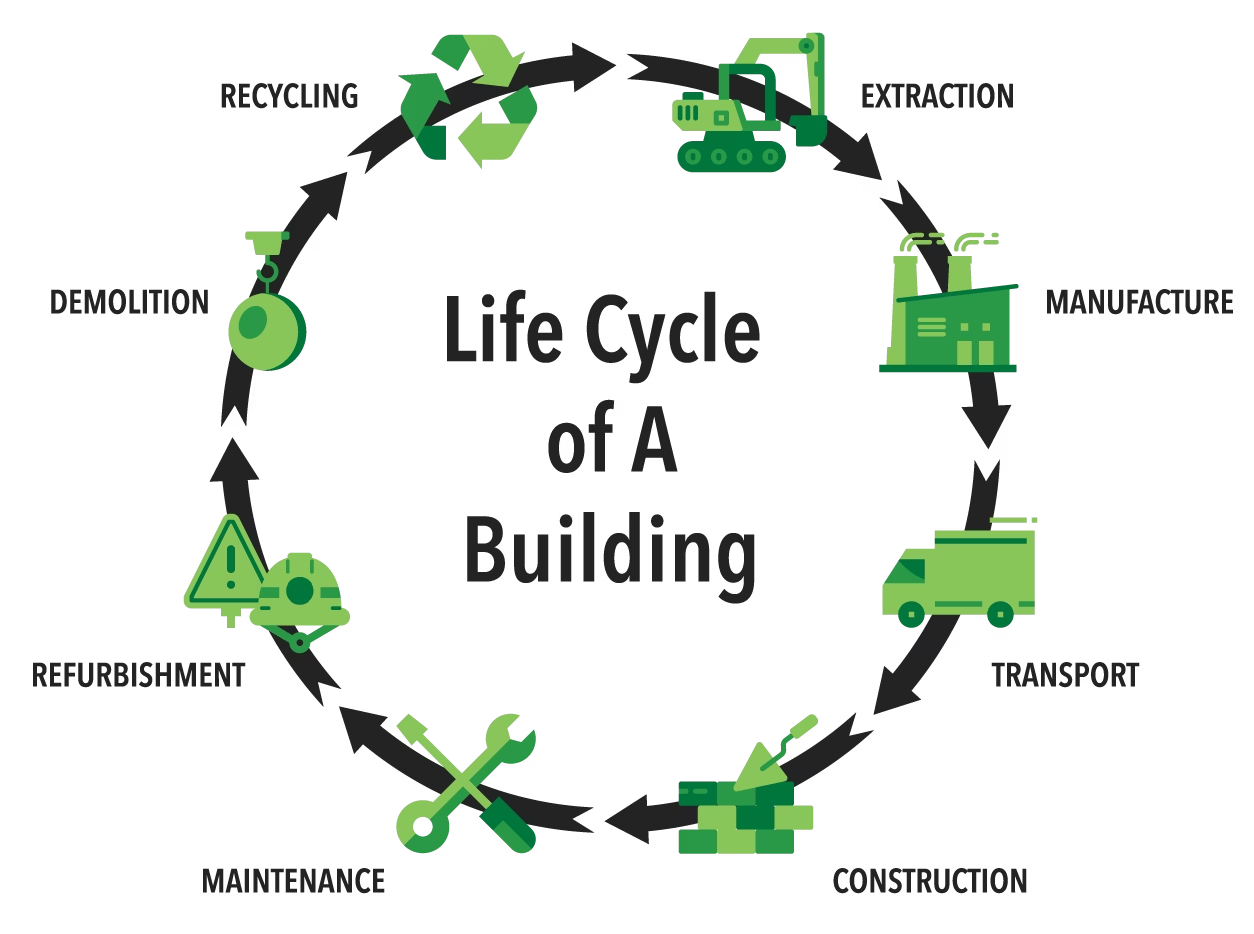
The Circular Economy in construction focuses on maximising the efficient use of resources and minimising waste throughout a building’s lifecycle, from design and construction to operation and deconstruction. Unlike the traditional “take, use, dispose” model, circular construction ensures that materials, products, and spaces are designed for longevity, adaptability, and reuse.
Embedding circular principles into the built environment can reduce environmental impact, extend the lifespan of materials, and create buildings that are not only resource-efficient but also resilient and future-proof.
Research from McKinsey and the World Economic Forum estimates that applying the circular economy to the built environment could reduce emissions at scale by 3.4 to 4.0 gigatonnes of carbon dioxide by 2050, representing roughly 75% of the built environment’s embodied carbon.
Building a Circular Ireland
In 2025 the IGBC published our Building A Circular Ireland roadmap, which lays out our vision for how Ireland’s construction sector can transition from a ‘take-use-dispose’ model to a fully circular system.
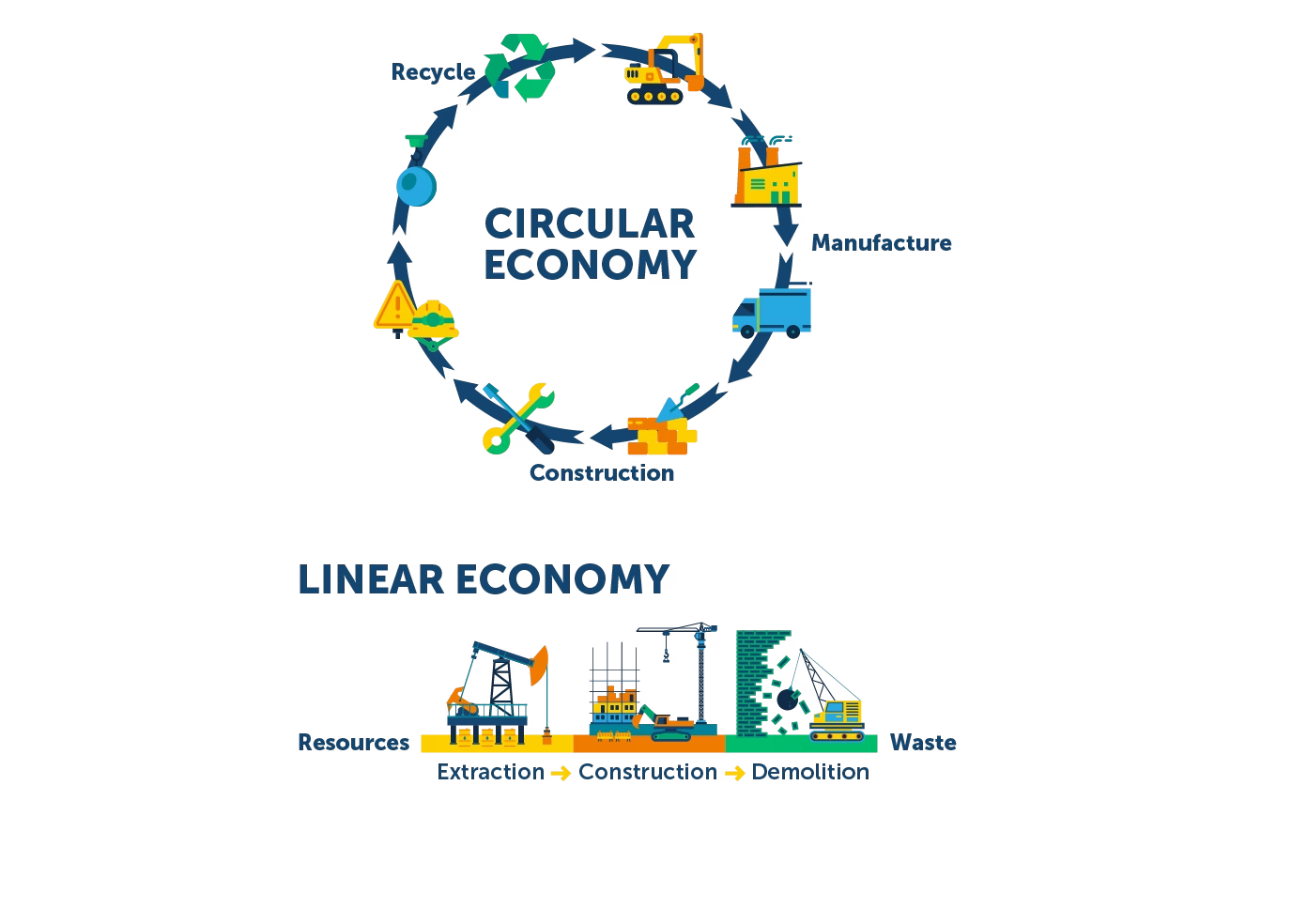
The Building A Circular Ireland roadmap uses the well-established ‘Waste Hierarchy’ approach to circularity, which prioritises waste prevention and reuse before recycling, with disposal the last option. The roadmap’s vision is based on the following key ideas:
Value our existing building stock
- Reduce vacancy and dereliction while regenerating our villages, towns and cities
- Retain and enhance the economic, social and cultural value of existing buildings and infrastructure
- Intensify the use of existing homes, buildings and infrastructure (e.g., schools with short opening hours and long holidays could facilitate community use at these times)
Plan our neighbourhoods for resource efficiency
- Prioritise compact urban growth, which makes more efficient use of roads, car parking, water, lighting and other infrastructure
- Support the sharing economy in the built environment, including shared amenities (e.g., car sharing and co-working spaces) and new housing models (co-operative housing, community-led housing and community land trusts)
Design buildings and infrastructure for circularity
- Adopt lean design and resource efficiency. This means using less materials and energy through efficient structural design and material use, and by optimising each building’s form factor
- Design for Adaptability, so it is possible to adapt buildings in future with minimal disruption (e.g., homes can be designed for life using a modular approach, to transition from a three-bed home to multiple one-bed units in future)
- Design for Deconstruction from the outset, to enable reuse of components and materials at the building’s end-of-life
Close the loop for construction materials
- Develop supply chains for low carbon biobased construction materials such as timber and agri-crops (for example, natural insulations from straw, wool, hemp, straw, reeds, flax and grasses)
- Adopt the Waste Hierarchy – prioritise prevention and preparing for reuse, and only dispose of materials as a last resort
Change to innovative new circular business models
- Develop supply chains for low carbon biobased construction materials such as timber and agri-crops (for example, natural insulations from straw, wool, hemp, straw, reeds, flax and grasses)
- Adopt the Waste Hierarchy – prioritise prevention and preparing for reuse, and only dispose of materials as a last resort
- Establish Extended Producer Responsibility schemes for construction materials, where manufacturers assume responsibility for the full product life cycle, to reduce waste and capture materials for reuse
- Incentivise manufacturers to switch to ‘Product as a Service’ where appropriate (e.g, leasing, rather than selling, an interior office fit out that is designed for disassembly). This places responsibility for the full product life cycle in the hands of manufacturers
Enable the circular transition through regulation, procurement and education
- Use public procurement to drive the circular economy
- Support the entire construction value chain to upskill in circularity and share their learnings
- Support digital solutions that enable traceability of components and materials in the circular economy, to facilitate adaptation, repair, deconstruction and reuse
- Ensure agile planning, regulation and certification systems that facilitate innovation for circularity while ensuring safety and compliance
IGBC’s work in this field

Circularity & resource efficiency are one of the key priorities for the Irish Green Building Council. We provide resources to help the construction and property industries embed circularity in their processes and projects.
We have a circularity newsletter issued quarterly to all members interested in this topic, a training course and many other publications you can find in the Knowledge Hub, including our “Building a Circular Ireland” Roadmap.
Guides
-

Circular Economy Playbook For The Built Environment Sector | Circular Construction Brief
Support industry stakeholders in the transition towards a decarbonised and circular built environment -

Circular Economy Playbook For the Built Environment | Circular Design Principles Brief
Support the industry stakeholders in the transition towards a decarbonised and circular built environment environment. -

Procurement Guidance
This factsheet illustrates how circularity can be embedded at the procurement phase. -

Pre-Demolition Guidance
How circularity can be embedded at the demolition and enabling phase, using Opera Square as a case example
Projects
-

-

Transition to a Circular Economy
Provide a Transition to Circular Economy Template and a Best Practice Guidance Document to assist builders in adopting circular practices within the Irish construction sector. -
Material Passports
Pioneering and promoting the Material Passport technology in the Irish Construction Sector -

-

Construction Materials Exchange
A digital platform to unlock the potential of excess construction materials.
Guide
Related content
-

Carbon Emissions & Net Zero in the Built Environment
The built environment has a critical role to play in addressing climate change by reducing both operational and embodied carbon emissions. -

Climate Adaptation and Resilience in the Built Environment
As climate risks increase, resilient buildings and neighbourhoods are critical to protecting people, places, and infrastructure. -

Health & Wellbeing in the Built Environment
Sustainable buildings are not only good for the planet, they are essential for healthier, fairer, and more resilient communities. -

Nature & Biodiversity in the Built Environment
Nature is in crisis, but the built environment has the potential to be part of the solution through planning and design that protects, restores, and enhances biodiversity. -

Life Cycle GWP Assessment – Methods and Resources
Overview The Irish Green Building Council (IGBC), as part of the INDICATE initiative, has developed a prototype Life Cycle Global Warming Potential (GWP) Assessment Methodology for Ireland. This methodology has […] -
Life Cycle Assessment tools and other useful links
There are many Life Cycle Assessment tools for performing building LCA. Here’s a list of LCA tools and useful links. Carbon Designer for Ireland (No Longer Available) One Click LCA […]