




Sustainable Urban Planning: Compact Growth Benchmarks
This post reviews the final National Policy Objectives (NPOs) on future development in Ireland.
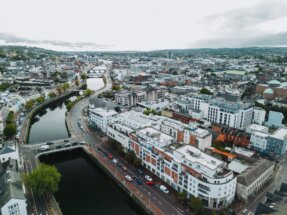
 Waterford City. Credits: 20twenty
About the author

In the previous two articles of this series (see here and here), we discussed the National Planning Framework’s (2025) goals for ‘balanced’ population growth across regions (National Policy Objective 2) and the greater concentration of population in Ireland’s cities and designated Regional Growth Centres (National Policy Objective 4).
This post reviews the final National Policy Objectives (NPOs) concerned with the distribution and form of future development across the country. NPOs 7, 8, and 9 focus on the delivery of compact growth within existing settlements. Each sets a percentage target for new homes to be built within the existing built-up footprint of Ireland’s cities, towns, and villages.
NPO 7 requires that 40% of new homes nationally be situated within the built-up area of existing settlements.
NPO 8 requires that 50% of new homes targeted for Ireland’s five cities (Dublin, Cork, Limerick, Galway, and Waterford) be situated within their urban boundaries. According to the 2018 version of the National Planning Framework, this is equivalent to 25% of new homes nationally being located within the five cities.
NPO 9 requires that 30% of new homes targeted for all other non-city settlements be situated within their urban boundaries. According to the 2018 version of the National Planning Framework, this is equivalent to 15% of new homes nationally being located within existing settlements.
Context: recent Irish settlement patterns
How, then, do these targets compare with recent trends in Irish settlement growth? In our previous post, we discussed growth in the five cities. This showed concentration in Dublin up to the 1970s, followed by a period of suburbanisation around the city’s hinterlands and commuter towns. Since the 1990s, growth has been evident both in the centre and periphery, though at higher rates in the commuter town belt. Similar trends were found for the remaining four second-tier cities, though with decentralisation occurring much more recently.
These observations are echoed in the recent history of growth in non-city settlements. Between 1966 and 2016, the most significant population growth took place in large towns of 10,000–50,000 people. Over this period, both the number of such settlements and their resident population approximately quadrupled. This settlement category’s share of the urban population also grew from 13% to 26% (McCafferty, 2019, p. 75).
This shift in population distribution at the settlement scale has been closely associated with patterns of growth in the Dublin and Mid-East sub-regions, and with the relationship between Irish cities and satellite towns more generally (Brady Shipman Martin, 2000, p. 68). Based on the 1966 census, Quinn (1971, p. 12) identified that the fastest-growing towns were those located within a certain distance of larger centres.
Williams and Shiels (2000, p. 49) made a similar observation for the 1991 to 1996 period. They found that the growth gap between Dublin-adjacent and non-Dublin-adjacent settlements increased with settlement size. McCafferty (2019, p. 74) supports this finding, showing that the settlements that expanded most between 1966 and 2016 were close to Dublin, Cork, or Waterford. Notably, none of these settlements had been designated for growth in national spatial policy. McCafferty (2019, p. 78) also found that distance from Dublin negatively correlates with population growth.
This research suggests that settlement-scale growth is strongly linked to a place’s size and position within a larger urban system.
Policy evaluation
So far, the target set by NPO 7 – that 40% of new homes nationally be situated within the built-up area of existing settlements – has been easily met. Between 2016 and 2024, an average of 75.5% of new dwellings were built within existing settlements. However, these figures cover settlements of all sizes, including both ‘urban’ and ‘rural’ classified settlements.
For urban settlements only, 69.7% of dwellings completed between 2016 and 2024 were within existing built-up footprints. For settlements with a population of 5,000 or more, the figure was 62.24%.
The national benchmark also obscures significant regional differences. Between 2016 and 2024, the Eastern and Midland Region achieved an aggregate rate of 85.9% for new dwelling completions within existing settlements. By contrast, the Southern Region achieved a rate of 65%, while the Northern and Western Region reached 45.7%.
When only urban settlements are considered, the disparity becomes more pronounced. The Eastern and Midland Region delivered 82.6% of new dwellings within existing built-up areas, compared with 55.1% in the Southern Region, and 36% in the Northern and Western Region. For larger settlements above 5,000 people, housing completions within existing built-up areas stood at 76.3% in the Eastern and Midland Region, 46.8% in the Southern Region, and 24.4% in the Northern and Western Region for the 2016–2024 period.
The NPO 8 target of locating 25% of new homes nationally within the five cities has also been achieved. Between 2016 and 2024, 36.8% of national dwelling completions occurred within existing city boundaries. Of this development, 80.2% took place within Dublin city and suburbs. Regional differences are again evident. In the Eastern and Midland Region, 48% of dwelling completions were located within the Dublin built-up footprint. In the Southern Region, 23.4% took place across Cork, Limerick, and Waterford cities. In the Northern and Western Region, 9.3% of dwellings were built in Galway city.
A similar figure has been reached in relation to NPO 9, which aims for 15% of new homes nationally to be located within existing settlements. 38.1% of dwellings completed within the built-up footprint of other non-city settlements between 2016 and 2024. Regional performance on this indicator has been relatively even: 37.9% of new dwellings were constructed within existing settlement boundaries in the Eastern and Midland Region, 41.7% in the Southern Region, and 36.3% in the Northern and Western Region.
However, as above, further divergences emerge when the analysis is restricted to urban settlements. These figures show 34.6% of all dwelling completions occurring within non-city urban settlements in the Eastern and Midland Region, compared with 31.8% in the Southern Region, and 26.6% in the Northern and Western Region.
Fundamentally, these findings show that national-scale measures are ineffective policy instruments for implementing compact growth. There are substantial differences in the percentage of new dwelling completions by region and settlement size. Aggregating these differences at the national level, or across settlement categories, conceals more localised disparities. As a result, NPF benchmarks may be met nationally because one region is experiencing extensive densification, while another continues to follow more dispersed patterns of development.
To account for this, compact growth targets should be increased and applied at the regional level. In addition, different dwelling location requirements for towns and cities should be removed. At present, the lower thresholds for non-city settlements reduce compact growth ambitions in regions dominated by smaller urban areas, as is the case in the Northern and Western Region.
References
Brady Shipman Martin. (2000). The Irish Urban System and its Dynamics. Department of the Environment and Local Government.
Government of Ireland. (2018). National Planning Framework. Government of Ireland.
Government of Ireland. (2025, April). National Planning Framework: First Revision. Government of Ireland.
McCafferty, D. (2019). Fifty years of urbanisation in Ireland: Structural and spatial evolution of the urban hierarchy since Buchanan. Administration, 67(3), 65–89.
Quinn, R. (1971). The Threat of Urbanisation in Ireland. Plan, 3(2), 10–13.
Williams, B., & Shiels, P. (2000). Acceleration into Sprawl: Causes and Potential Policy Responses (June 2000; Quarterly Economic Commentary, pp. 37–73). Economic and Social Research Institute.
Sustainable Urban Planning Series
Previous Articles
-

Sustainable Urban Planning: An introduction to Irish spatial policy in 2025
The Irish Green Building Council is launching a new blog series, “Sustainable Urban Planning,” by Michael Hayes, an… -
Sustainable Urban Planning: Population Growth and Location
This posts examine contemporary policy at the national and regional scales in relation to sustainable urban development. -

Sustainable Urban Planning: Population Targets for Ireland’s Cities
Following our previous post on National Policy Objective 2, this post continues our focus on contemporary Irish spatial… -
Sustainable Urban Planning: Urban Boundaries and Their Impacts
Previous articles in this series have provided an overview of how spatial policy in Ireland structures plans across… -

Sustainable Urban planning: Settlement Hierarchies and Compact Growth in Ireland
In the first post of this article series, we looked at how plans are structured in Irish spatial…
News
More news from IGBC
-

IGBChats #20: DGNB Independent Review: A First for EU Taxonomy in Ireland
How one Irish project is testing alignment beyond self- assessment -

Comparing ISO 14001 and the CO2 Performance Ladder
Discover the key differences and connections between ISO 14001 and the CO₂ Performance Ladder. -
World Green Building Week 2026
World Green Building Week returns this September with an exciting programme of events across Ireland. -

IGBC Brings the Sustainable Built Environment’s Voice to Ireland’s Draft Nature Restoration Plan
Protecting and enhancing biodiversity in the built environment is one of the Irish Green Building Council’s core priorities.... -
2026 Mid-Year EPD Update
The first half of 2026 has been another significant period for EPD Ireland, with a wide range of... -

From Measurement to Action: How the CIF Carbon Calculator and the CO₂ Performance Ladder Work Together
As Ireland accelerates its efforts to decarbonise the built environment, organisations across the construction sector face growing challenges...