

Irish Green Building Council’s reaction to Budget 2026
The Irish Green Building Council (IGBC) welcomes positive steps on urban regeneration and energy retrofit in Budget 2026,...

About the author

The Irish Green Building Council (IGBC) welcomes positive steps on urban regeneration and energy retrofit in Budget 2026, but stresses that critical opportunities to deliver quality, sustainable homes at scale and to reduce our carbon emissions have been missed.
Irish Green Building Council CEO Pat Barry said: “Budget 2026 contains some positive steps for the built environment, with policies that should help to deliver more homes in urban locations, regenerate town and village centres, and protect the most vulnerable from energy poverty. However, many of its measures aren’t radical enough to tackle the housing and climate crises. In particular, more must be done to address vacancy and deliver quality, sustainable homes at scale.”
Vacancy & Dereliction
The IGBC welcomes the extension and enhancement of the Living City Initiative and the proposal for a new derelict property tax to be collected by the Revenue Commissioners. These are steps in the right direction, but the proposed measures are likely insufficient to rejuvenate our urban and rural centres. A holistic, integrated approach is needed, including upfront feasibility grants and the establishment of multi-disciplinary vacancy teams in local authorities to fully support the use of “over the shop” premises for residential purposes. Clarity is also needed in Housing for All 2.0 on a timeline to improve planning policies and building regulations to support conversion, adaptive reuse, and intensification of use over demolition and new construction.
Energy Retrofit
The IGBC also welcomes the increase in funding for SEAI and local authorities to retrofit homes but regrets that it does not go far enough to address the underlying issues. More targeted supports are needed to meet our energy retrofit targets and tackle fuel poverty. In particular, many homeowners who don’t qualify for the Warmer Homes Schemes but can’t afford an energy upgrade under existing schemes require specific support. Likewise, additional mechanisms are needed to better support specific cohorts, such as tenants in the private rental sector. Equally, more technical support and guidance are needed. This could be delivered through well-resourced community energy advice hubs located in each local authority.
Compact urban growth
The emphasis on closing the viability gap for higher-density apartments is to be welcomed, but this additional support should be targeted to ensure the apartments are built using low-carbon construction methods, and in sustainable locations, in particular on brownfield sites. Building within the existing urban fabric reduces the carbon emissions associated with transport and new infrastructure, as well as their cost.
News
More news from IGBC
-
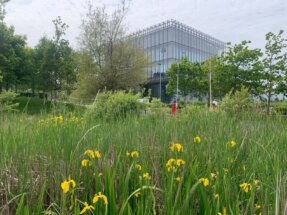
IGBC Brings the Sustainable Built Environment’s Voice to Ireland’s Draft Nature Restoration Plan
Protecting and enhancing biodiversity in the built environment is one of the Irish Green Building Council’s core priorities.... -

2026 Mid-Year EPD Update
The first half of 2026 has been another significant period for EPD Ireland, with a wide range of... -

From Measurement to Action: How the CIF Carbon Calculator and the CO₂ Performance Ladder Work Together
As Ireland accelerates its efforts to decarbonise the built environment, organisations across the construction sector face growing challenges... -

Timber in Construction Steering Group’s Final Report Published
The Irish Green Building Council welcomes the publication of the interdepartmental and industry Timber in Construction Steering Group’s... -

Sustainable Urban Planning: Population Targets for Ireland’s Cities
Following our previous post on National Policy Objective 2, this post continues our focus on contemporary Irish spatial... -
Faster decarbonisation of buildings will increase resilience to energy price shocks
Progress has been made on policies to decarbonise our built environment in recent years but the government must...